
When Private Markets Start to Look Like an Index: Wellington's H2 2026 Warning
The case for private markets has always rested on access to returns that public markets can't deliver, but Wellington Management's midyear venture capital outlook, published 6 July 2026, raises an uncomfortable question: what happens when private markets start to resemble the public index they were supposed to diversify away from?
In their view, the answer is already playing out.
The Concentration Problem
In Q1 2026, the top five venture managers by capital raised captured 73.1% of all venture commitments. The top 15 firms captured 88.5%. On the deal side, the five largest financings accounted for nearly $200 billion in investment, pushing the top-five share of total venture deal value above 70%, the highest recorded level in the asset class's history.
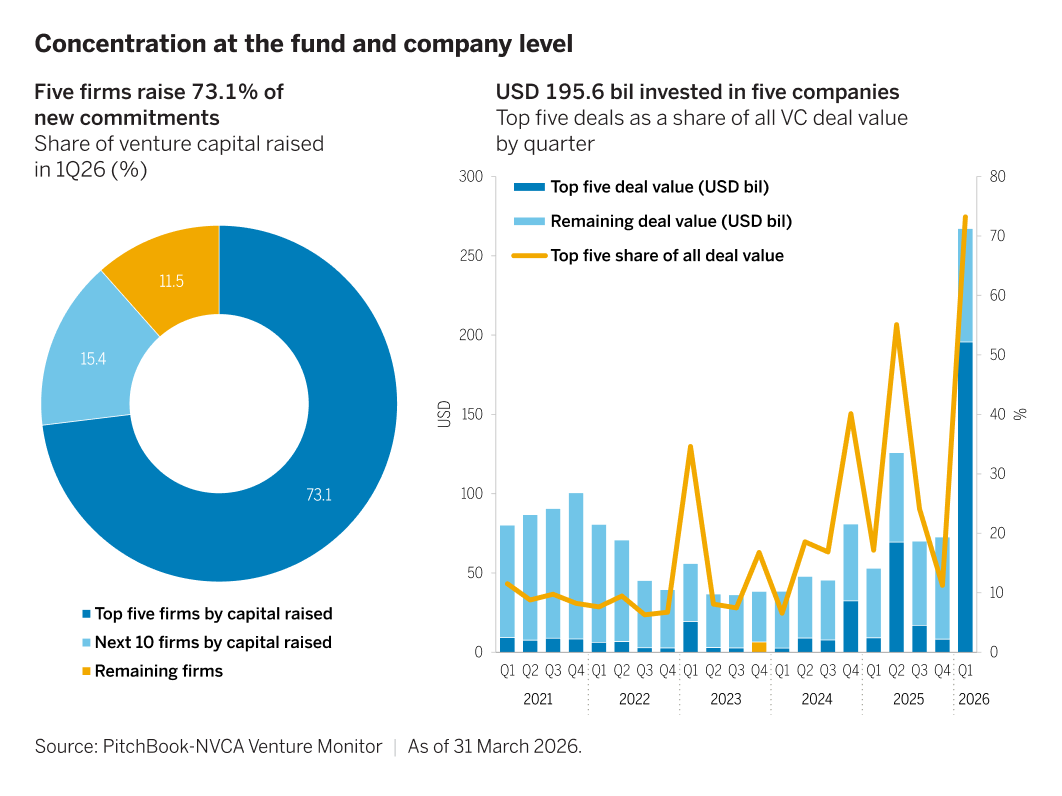
Source: PitchBook-NVCA Venture Monitor via Wellington Management, as of 31 March 2026
Wellington's Investment Directors William Craig and Mark Watson describe the result as the emergence of "venture/growth mega-cap indices," where large funds and publicly listed closed-end vehicles effectively create broad-based exposure to the same set of leading AI companies. For allocators invested across several large managers, the report notes, this means overlapping exposures across portfolios, mirroring how public market mega-cap names have dominated index returns in recent years.
The parallel to public markets is the point: an investor who owns positions in three or four large private market funds may have significant exposure to the same dozen companies, at similar entry points, with similar exit timelines. That is not alpha - that is beta dressed as private market access.
The Laffont Counterpoint
This sits in direct tension with the thesis Thomas Laffont put forward at the All-In Liquidity Summit in June, which we covered recently. Laffont's argument was that centacorns, companies already valued above $100 billion, have a 31% probability of delivering another 10x return, higher than earlier-stage bets.
Concentrate in the winners.
Wellington's counterargument is not that Laffont is wrong about company quality. It is that entry price increasingly matters as much as company quality, and that at current valuations, even the strongest AI companies may deliver modest multiples depending on when and how you got in. The question has shifted, in Wellington's framing, from "is this a great company?" to "what return is realistically achievable from this entry point, and what alternatives exist?"
Both arguments can be right simultaneously. A centacorn can be an exceptional business and still be a poor investment at a given price. The two are not mutually exclusive.
The Barbell and What It Leaves Behind
Wellington describes private markets as developing a barbell structure. At one end, mega-cap AI rounds are dominated by sovereign wealth funds, hyperscale cloud providers, and large crossover funds where check size and strategic relevance determine access. At the other end, smaller and more specialised companies, both inside and outside AI, are too small to move the needle for a $5 billion or $10 billion platform, which means they receive less competition and potentially lower entry valuations.
The math explains why. A $5 billion growth fund seeking a 3x gross multiple needs approximately $15 billion in gross proceeds. A $50 million investment that returns 5x generates $250 million in gross proceeds. Strong in absolute terms, but only 4% of the fund's capital and about 1.7% of the gross proceeds required to hit the fund target. For a large platform, the opportunity cost of pursuing that deal is too high to justify.
That constraint creates an opening. Wellington argues that underfollowed sectors including consumer, financials, and healthcare represent a less efficient opportunity set where capital is scarcer, entry valuations are lower, and the potential for differentiated returns is higher. These are not consensus trades, which is precisely the point.
Four Frameworks for Portfolio Construction
Wellington distils the practical guidance for allocators into four questions worth asking before building any private market allocation.
Look through portfolios holistically. Aggregate exposure across managers, particularly to large AI names, can be significantly higher than any single fund's stated concentration would suggest. Understanding actual exposure requires look-through analysis, not just reading fund mandates.
Distinguish beta from alpha. Mega-cap private market exposure may increasingly deliver beta-like returns similar to public market large-cap indices. Small to mid-cap private investing, where less capital competes for access, may offer greater potential for differentiated alpha.
Assess managers excluding mega-deal contributions. Some managers' historical returns have been driven disproportionately by a small number of large AI positions. Evaluating performance with and without those positions gives a clearer picture of whether the underlying strategy is repeatable.
Consider diversification across cap sizes. An "all-cap" private market approach that spans mega-, mid-, and small-cap private companies offers a wider opportunity set and reduces the concentration risk that comes from positioning primarily in consensus names.
What This Means for Wholesale Investors
Wellington's report is written for institutional allocators, but the underlying argument applies directly to individual wholesale investors building private market exposure.
The most accessible private market vehicles, including the listed closed-end funds we covered in our piece on retail access to private markets, already exhibit the index-like concentration Wellington describes. VCX and Robinhood Ventures both hold positions in the same handful of AI companies that dominate institutional portfolios. The diversification argument for private markets weakens when every structure points at the same names.
The implication for wholesale investors using SPV structures is different, because SPVs allow concentrated positions in individual companies at specific negotiated entry prices. That specificity is both the risk and the advantage: a single-company SPV is not an index, which means it can underperform or outperform depending on the specific company, structure, and timing. Wellington's framework suggests that the entry price question deserves at least as much attention as the company quality question when evaluating any private market opportunity.
As always, the risks of private market investing, including illiquidity, valuation opacity, and concentration, apply regardless of which part of the market an investor is accessing.
NonPublic Pty Ltd (ABN 49 607 216 928) holds Australian Financial Services Licence #482668. Investments are available to wholesale and sophisticated investors as defined under the Corporations Act 2001. This content is general in nature and does not constitute financial product advice. It does not take into account your objectives, financial situation, or needs. Investing in private markets involves significant risk, including the potential loss of your entire investment. Past performance is not a reliable indicator of future results. You should obtain independent financial advice before making any investment decision.
