
86% of Wealth Advisors Are Increasing Private Market Allocations in 2026
Hamilton Lane's 2026 Global Private Wealth Survey, published in January and covering 390 financial advisors across the Americas, Europe, the Middle East, and Asia-Pacific, puts a number on something increasingly visible in how institutional allocators are positioning: private markets are no longer a specialist allocation. They are becoming a standard component of a wealth portfolio, and the shift is happening faster than most of the public commentary around private markets suggests.
The Headline Numbers
Three figures from the survey define the current state of play:
86% of private wealth professionals plan to increase private market allocations in 2026, with portfolio optimisation as the top motivator
83% view the private market risk/reward as comparable to public markets or better, directly contradicting the conventional assumption that illiquidity makes private markets inherently riskier
81% report that client education significantly boosts interest in private markets, pointing to knowledge gaps as the primary remaining barrier rather than risk appetite or return scepticism
Source: Hamilton Lane 2026 Global Private Wealth Survey
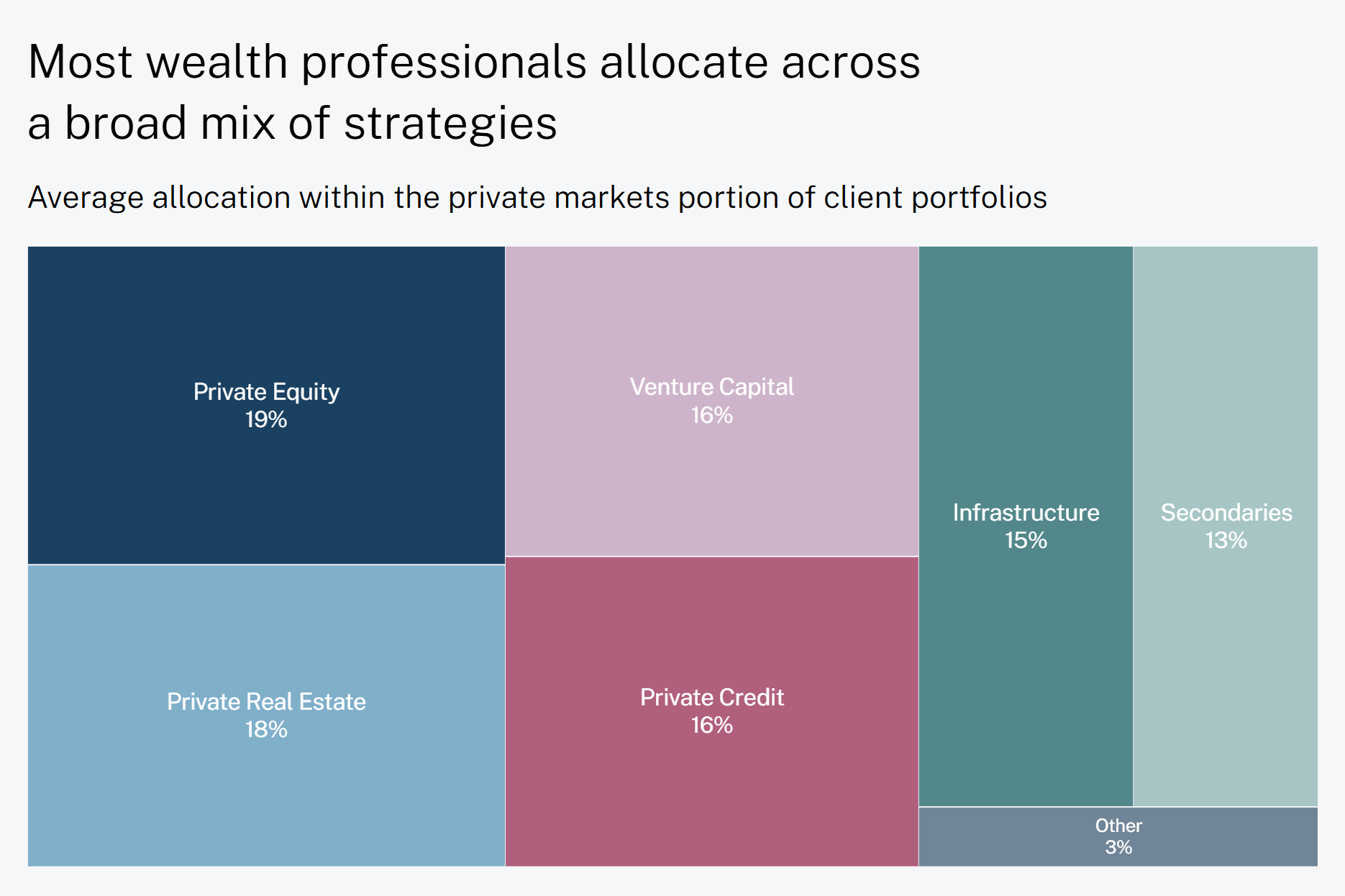
The strategy breakdown across current allocations is notably even:Private Equity at 19%, Private Real Estate at 18%, Private Credit at 16%, Venture Capital and Growth at 16%, and Private Infrastructure at 15%. This spread matters because it contradicts the narrative that private market demand is purely an AI and venture story. Infrastructure and private credit are growing alongside VC, which suggests the expansion is structural rather than thematic.
What Is Driving the Shift
The risk perception finding is the most significant data point in the survey. The conventional argument against private markets for individual investors has always rested on illiquidity and opacity making them inherently riskier than listed equivalents. That argument has largely been retired among the advisor population this survey covers.
Private markets carry different risks from public markets rather than simply more risk. Illiquidity is real, valuation opacity is real, and concentration risk is real, as we covered in ourpiece on the risks of private market investing, but the 83% figure suggests advisors are increasingly comfortable holding those risks alongside the return potential they offer rather than treating illiquidity as an automatic disqualifier.
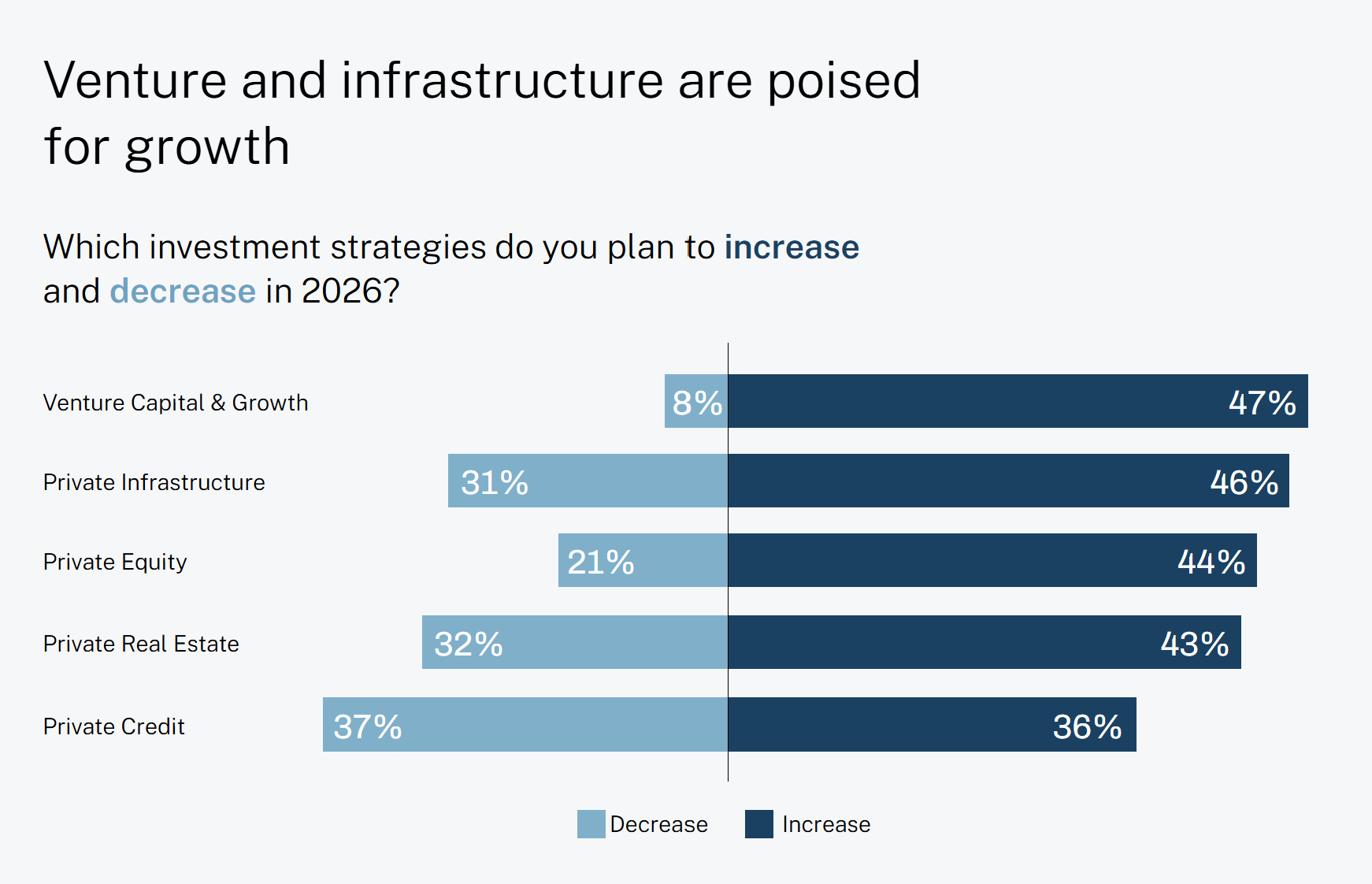
The infrastructure number is the more surprising one. Planned increases by strategy for 2026:
Venture Capital & Growth: 47% plan to increase, 8% to decrease
Private Infrastructure: 46% plan to increase, 31% to decrease
Private Equity: 44% plan to increase, 21% to decrease
Private Real Estate: 43% plan to increase, 32% to decrease
Private Credit: 36% plan to increase, 37% to decrease (the only strategy where decreases outpace increases)
Given the AI-driven energy demand build-out we covered in ourpiece on energy infrastructure and AI, the infrastructure allocation trend is not coincidental. Advisors are rotating toward the physical infrastructure layer, not just the software and model companies on top of it.
Source: Hamilton Lane 2026 Global Private Wealth Survey
The Education Gap
The 81% education figure is the most underreported finding in the survey, and the most relevant for anyone thinking about how private market access actually expands beyond institutional investors.
The survey makes clear that the primary remaining friction is not return scepticism or risk aversion: it is knowledge. Advisors who educate clients on private market mechanics, structures, and risk profiles see materially higher interest. The implication is that the demand for private market exposure among wealthy individuals is latent rather than absent, and education is the mechanism that converts latent interest into allocation decisions.
This is consistent with what Hamilton Lane's own client data shows.James Martin, Head of Global Client Solutions at Hamilton Lane, noted that investors and their advisors are becoming more sophisticated around assessing risk/reward trade-offs, and that there is a strong link between education and interest in the asset class. Private market adoption among wealth advisors is accelerating, but it has not peaked.
The Access Gap
The 390 advisors surveyed work with private wealth firms, RIAs, and family offices, clients who have historically had access to private market structures that individual wholesale investors have not. Hamilton Lane manages $1 trillion in assets and its survey population reflects that client base.
The direction of the data is clear even if the access gap persists.97% of private wealth professionals surveyed already allocate between 1% and 20% of their book to private markets, and the majority expect that share to grow. The institutional layer of wealth management has already made this allocation decision. The question is which structures and platforms bring that same exposure to investors below the typical institutional minimum.
The Hamilton Lane survey confirms that demand is there and growing. How you access it (the structure, the terms, the entry point) is where the real difference sits. Ourguide to qualifying as a wholesale investor in Australia and ourpiece on what retail access actually looks like cover the gap in detail.
NonPublic Pty Ltd (ABN 49 607 216 928) holds Australian Financial Services Licence #482668. Investments are available to wholesale and sophisticated investors as defined under the Corporations Act 2001. This content is general in nature and does not constitute financial product advice. It does not take into account your objectives, financial situation, or needs. Investing in private markets involves significant risk, including the potential loss of your entire investment. Past performance is not a reliable indicator of future results. You should obtain independent financial advice before making any investment decision.
