
The Q2 2026 Venture Monitor: Record Numbers, Narrow Recovery
TheQ2 2026 PitchBook-NVCA Venture Monitor landed on July 8 with a headline that sounds unambiguously positive: US startups raised more than $400 billion in the first half of 2026, surpassing every previous full-year investment total on record and already exceeding all of 2025. The details underneath that number are where the real picture sits.
What the Data Actually Shows
Megadeals of $100 million or more captured 87.5% of the $412.7 billion deployed in H1 2026. AI accounted for 86% of all venture dollars. Three firms, Andreessen Horowitz, Thrive Capital, and Founders Fund, took in 48.1% of all capital raised. First-time fund formation is on pace for its lowest year since 2016.
The market is setting records at the very top while contracting in almost every other segment underneath it. AI companies' proportion of all completed deals has risen every quarter but one since 2022, reaching 42.5% of deal count in Q1 2026, compared with 14.6% a decade ago. The recovery is real, just not evenly distributed.
Three Numbers Worth Sitting With
87.5% — the share of all H1 2026 venture dollars that went into deals of $100 million or more. Earlier-stage companies across seed, Series A, and Series B are competing for the remaining 12.5%.
86% — the share of all venture dollars flowing to AI companies. Every other sector, from fintech to biotech to climate, is raising in a market where AI has effectively crowded out non-consensus bets.
48.1% — the share of all venture fundraising captured by three firms. For LPs, the diversification argument for committing to a broad range of VC managers is becoming harder to make when half the capital ends up in three places.
What Is Happening to Early-Stage Companies
The 12.5% figure deserves more attention than it typically gets in headlines focused on record totals. Seed and Series A companies are not just raising smaller rounds, they are raising in a market where the structural incentives for large platforms to compete for their deals have weakened. A $10 billion fund needs to write large checks into large companies to move the return needle. A $500K seed check into a promising founder is not worth the diligence cost.
First-time fund formation being on pace for its lowest year since 2016 compounds this. First-time managers have historically been the most active capital providers at the earliest stages, willing to take earlier bets and lower valuations because their fund economics require it. Fewer first-time funds mean fewer buyers in the market that early-stage founders depend on, which means the early-stage market is tighter than the headline $412 billion suggests.
The companies that raised at 2021 valuations and have not yet exited face a specific version of this pressure. They need follow-on capital to extend runway, but the valuations that made their last rounds look attractive look very different in a market where 87.5% of dollars are going into megadeals at the top.
What This Means for the Exit Market
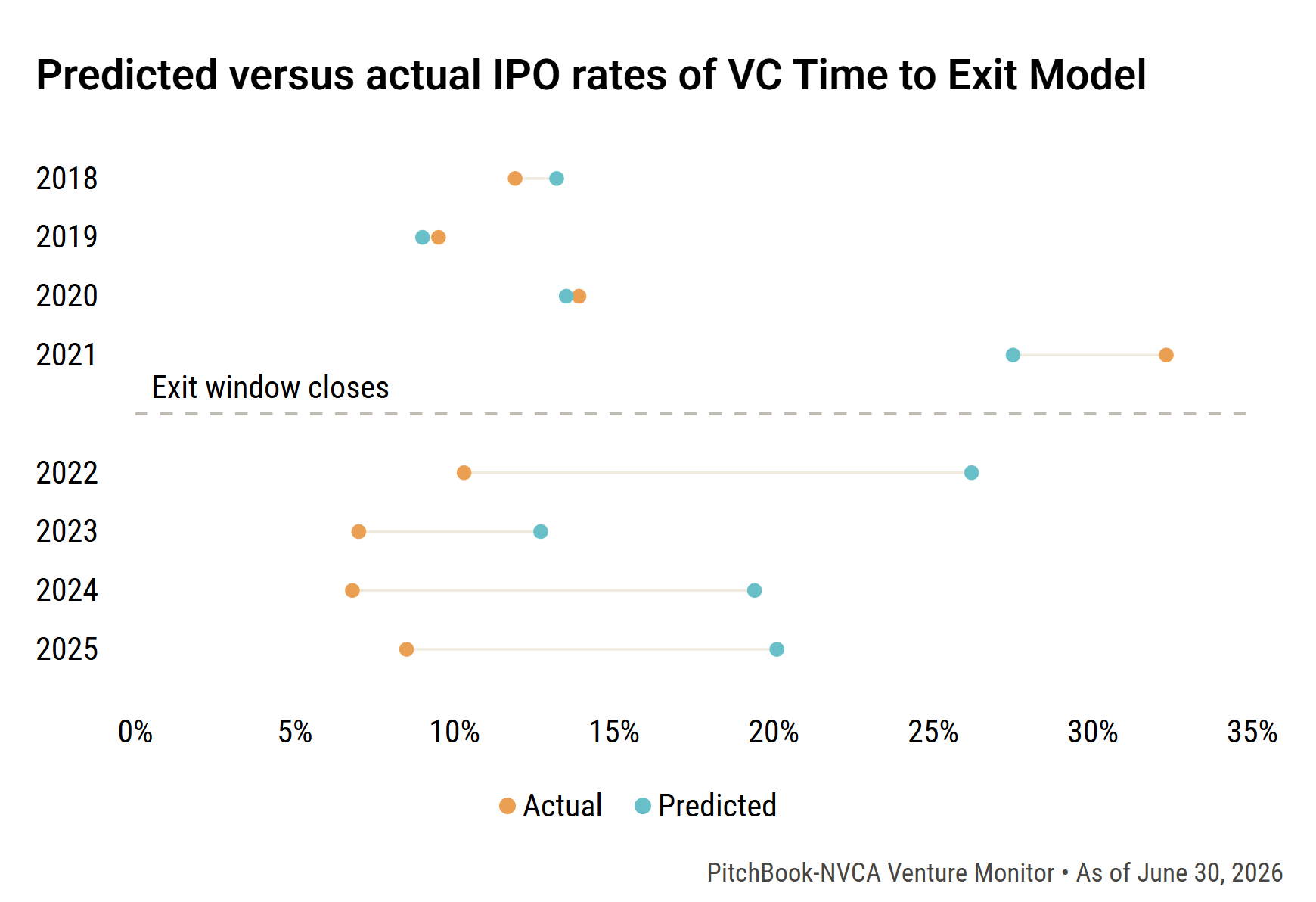
Exit activity improved during Q2, as IPOs and M&A accelerated, but PitchBook's own Time to Exit Model tells a more sobering story about the backlog.
Source: PitchBook-NVCA Venture Monitor, as of June 30, 2026
The chart shows predicted IPO rates for 2022, 2023, 2024, and 2025 vintages running materially above actual rates across the board, with the gap widening for the 2022 and 2024 cohorts in particular. Companies that should have IPO'd based on historical time-to-exit models have not, because the exit window closed in 2022 and only partially reopened in 2026. SpaceX's June listing was the defining exit event of H1 and the first real test of whether the IPO market could absorb a private company at multi-trillion-dollar scale. As we covered in ourpiece on how SpaceX split the AI IPO timeline for OpenAI and Anthropic, the early answer is that the market can absorb it, but not without volatility, which is exactly why OpenAI pushed its timeline to 2027 and Anthropic is racing to list in October before conditions change.
The unicorn backlog remains substantial. SpaceX, Anthropic, OpenAI, Stripe, and Databricks represent an enormous amount of unrealised value sitting in private portfolios. PitchBook estimates the top five potential IPOs alone would provide a windfall that dwarfs any single prior exit cycle. How that value transfers to public markets over the next 12 to 18 months will determine whether the H1 2026 recovery broadens or stays as concentrated as the investment numbers suggest.
The Wellington Counterpoint
The concentration data in the Venture Monitor connects directly to what Wellington Management flagged in theirmidyear venture outlook: the current private market cycle is increasingly defined by a narrow set of consensus opportunities, with the top five managers capturing 73.1% of all venture commitments in Q1 2026 and the top five deals accounting for more than 70% of total deal value, the highest share ever recorded.
The PitchBook data confirms Wellington's thesis empirically. When 87.5% of dollars go into megadeals and 86% go to AI, the segments outside that consensus are by definition less efficiently priced. First-time fund formation at its lowest since 2016 means fewer new managers competing for non-consensus deals, and historically that kind of supply contraction in early-stage capital has preceded periods where patient investors in less trafficked segments outperform.
Wellington's practical recommendation was to look at underfollowed sectors in consumer, financials, and healthcare, where capital is scarcer and entry valuations are lower. The PitchBook data gives that recommendation a concrete empirical foundation: the market is structurally constrained in its ability to distribute capital broadly, and that constraint creates the conditions for differentiated returns outside the consensus.
What This Means for Wholesale Investors
The record funding numbers are real, but they are not evenly distributed, and the distinction changes how you think about accessing private markets. An investor who accesses private markets through a broad-based venture fund is, in today's market, largely buying exposure to the same dozen AI companies through a fee-paying wrapper. An investor who accesses specific companies through structured SPV positions is making a different kind of bet: more concentrated, more legible, and more directly connected to the specific thesis they are expressing.
The concentration at the top is an argument for being specific about which part of the market you are accessing and why. Ourguide to private market asset classes covers the structural differences across strategies in detail, and ourpiece on the risks of private market investing covers what concentration and illiquidity risk actually look like in practice.
NonPublic Pty Ltd (ABN 49 607 216 928) holds Australian Financial Services Licence #482668. Investments are available to wholesale and sophisticated investors as defined under the Corporations Act 2001. This content is general in nature and does not constitute financial product advice. It does not take into account your objectives, financial situation, or needs. Investing in private markets involves significant risk, including the potential loss of your entire investment. Past performance is not a reliable indicator of future results. You should obtain independent financial advice before making any investment decision.
