
Kimi K3 Is the Largest Open-Weight Model Ever. Why Does That Matter for Anthropic and OpenAI?
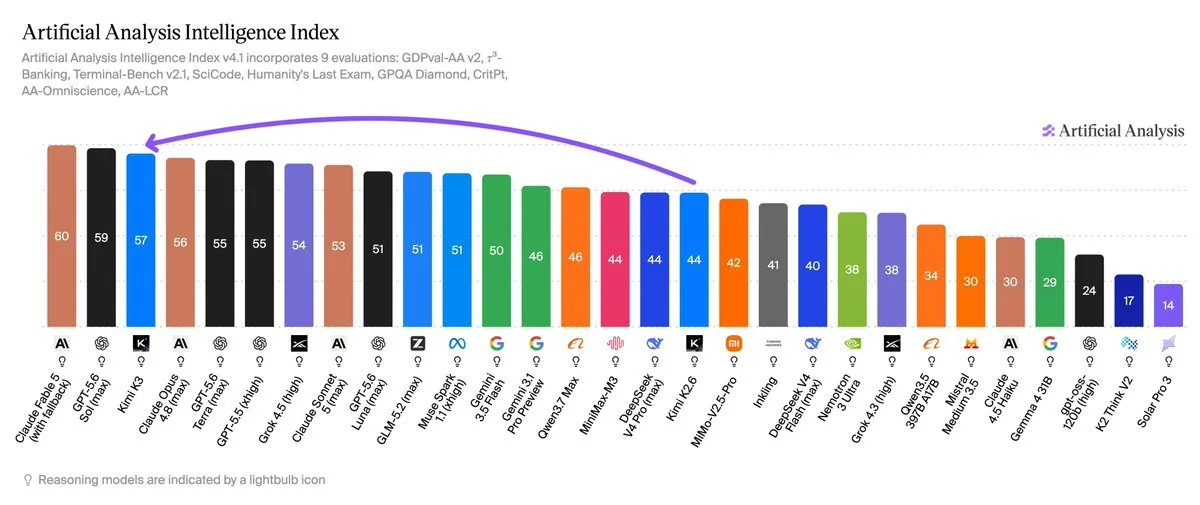
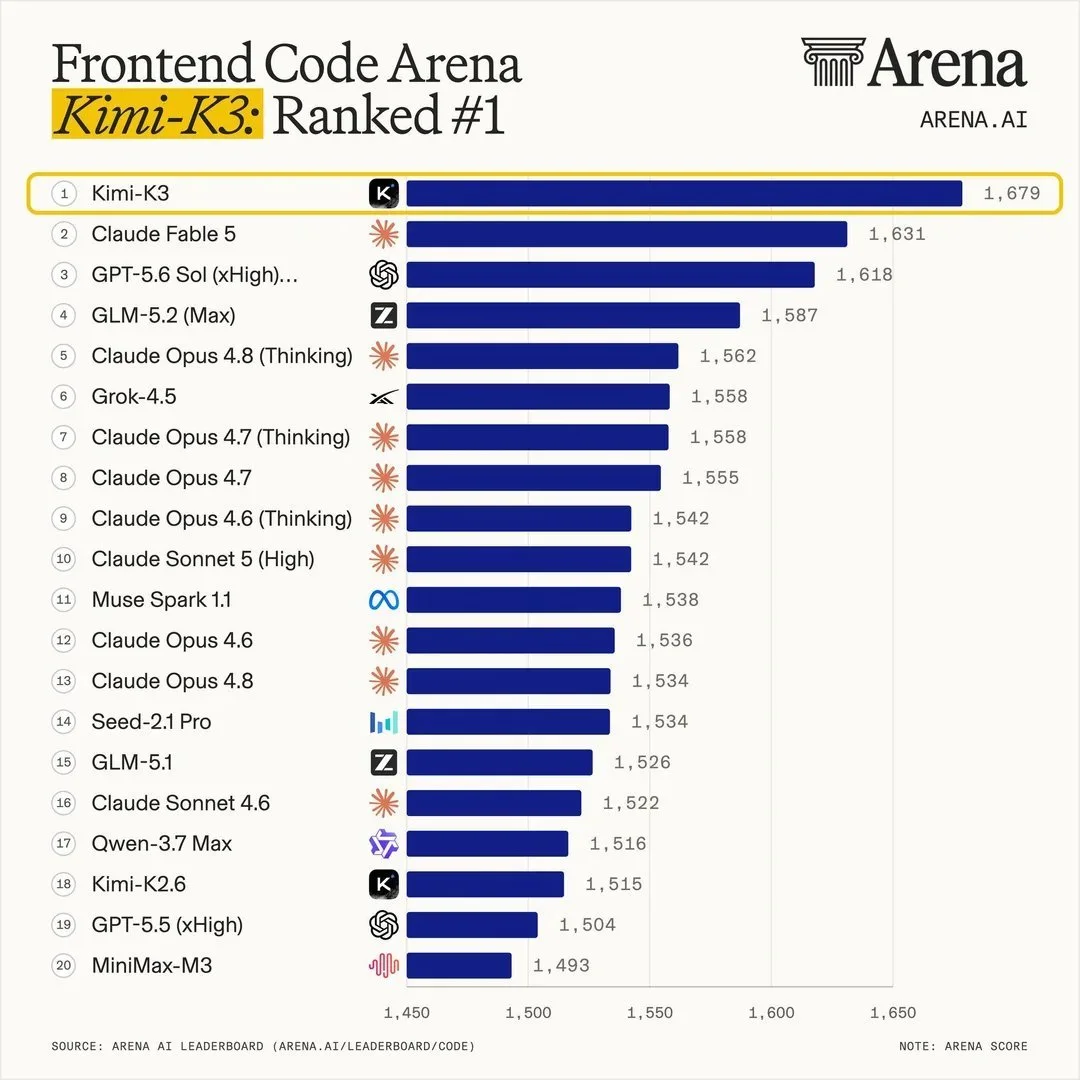
Moonshot AI launched Kimi K3 on July 16, a 2.8 trillion parameter Mixture-of-Experts model with a 1 million token context window, making it the largest open-weight model ever released. Within hours, Arena.ai ranked it #1 on the Frontend Code Arena with 1,679 points, surpassing Claude Fable 5, a 17-place jump from Kimi K2.6. On the Artificial Analysis Intelligence Index, it scores 57, ranking third overall behind Fable 5 and GPT-5.6 Sol. The technical specs matter, but the business model underneath them is the more consequential story for investors.
What Kimi K3 Actually Is
K3 is a Mixture-of-Experts architecture, activating 16 of 896 experts per token, built on Moonshot's Kimi Delta Attention architecture with native vision and multimodal capabilities. Kimi Delta Attention enables up to 6.3x faster decoding in million-token contexts, and Attention Residuals deliver approximately 25% higher training efficiency at less than 2% additional compute cost. At launch it scored 93.5% on GPQA Diamond, 91.2% on BrowseComp, 88.3% on Terminal-Bench 2.1, and 42.0% on SWE Marathon, the strongest open-weight results on those benchmarks at time of publication. Agentic coding, browser tasks, and long-context work are where it leads.
Pricing is aggressive: $0.30 per million input tokens (cache hit), $3.00 (cache miss), and $15.00 per million output tokens. GPT-5.5 runs at $5 per million input and $30 per million output. The full 2.8 trillion parameter model weights will be released publicly by July 27, making it freely downloadable, modifiable, and deployable by any developer anywhere.
Moonshot shipped five flagship models in eleven months. It passed $300 million in annualised recurring revenue by mid-June and closed a $2 billion round at a $20 billion valuation in May 2026, now reportedly raising fresh capital at a $31.5 billion valuation.
The Open vs Closed Divide
K3 is a deliberate competitive strategy against Anthropic and OpenAI's closed-weight approach, and it matters for how investors should think about the AI companies approaching public markets in 2026. Anthropic and OpenAI both rely on closed models accessible only via API subscription, which generates predictable recurring revenue but creates a specific vulnerability: every time a capable open-weight model ships at a fraction of the cost, enterprise customers have a reason to reconsider whether the premium is justified. The Financial Times cited industry sources saying K3 could challenge the long-held assumption that Chinese frontier models lag their US counterparts by 8 to 12 months, and that gap compressing is a direct pricing pressure on Anthropic and OpenAI's API businesses.
DeepSeek ran the same playbook in January 2025 with R1. Enterprise interest in Chinese open-weight models has grown since, with executives increasingly proposing them as cost-effective and privacy-conscious alternatives to closed US platforms. K3 is the next version of that pressure, at a larger parameter count and with stronger agentic benchmark results.
One caveat worth holding: independent benchmark verification is still in progress. Moonshot's own figures and early user reports suggest strong performance, but the "beats everything" claims circulating on social media are ahead of verified third-party testing. The specs and pricing are confirmed. Whether it holds up across the full range of enterprise use cases will take weeks to establish.
What This Means for Anthropic and OpenAI Pre-IPO Investors
Anthropic is targeting an October 2026 Nasdaq listing at a $965 billion valuation. OpenAI is pushing toward 2027 at a $1 trillion target. Both valuations rest in part on the defensibility of their model performance advantage and their ability to sustain API pricing as open-weight competition intensifies.
Anthropic's Fable 5 remains ahead of K3 on overall intelligence benchmarks, and both companies have advantages in safety research, enterprise relationships, and regulatory positioning that open-weight models do not easily replicate. The Artificial Analysis Intelligence Index shows Fable 5 leading K3 by a clear margin on the overall score. What K3 does is compress the timeline on a risk already embedded in both companies' S-1 disclosures: that open-weight models close the capability gap fast enough to erode API pricing power before either company reaches the revenue scale needed to justify a trillion-dollar public market valuation. For investors assessing Anthropic's October listing or OpenAI's 2027 timeline, the relevant question is not whether K3 beats Fable 5 today, but how many more Kimi K3s ship before either company lists, and what that does to enterprise customers' willingness to pay full API rates.
As we covered in our piece on how SpaceX split the AI IPO timeline for OpenAI and Anthropic, the window between now and listing day is where the most important variables will be set. Open-weight model competition is one of them.
NonPublic Pty Ltd (ABN 49 607 216 928) holds Australian Financial Services Licence #482668. Investments are available to wholesale and sophisticated investors as defined under the Corporations Act 2001. This content is general in nature and does not constitute financial product advice. It does not take into account your objectives, financial situation, or needs. Investing in private markets involves significant risk, including the potential loss of your entire investment. Past performance is not a reliable indicator of future results. You should obtain independent financial advice before making any investment decision.
