
The 2021 Vintage Has Returned 5 Cents on the Dollar
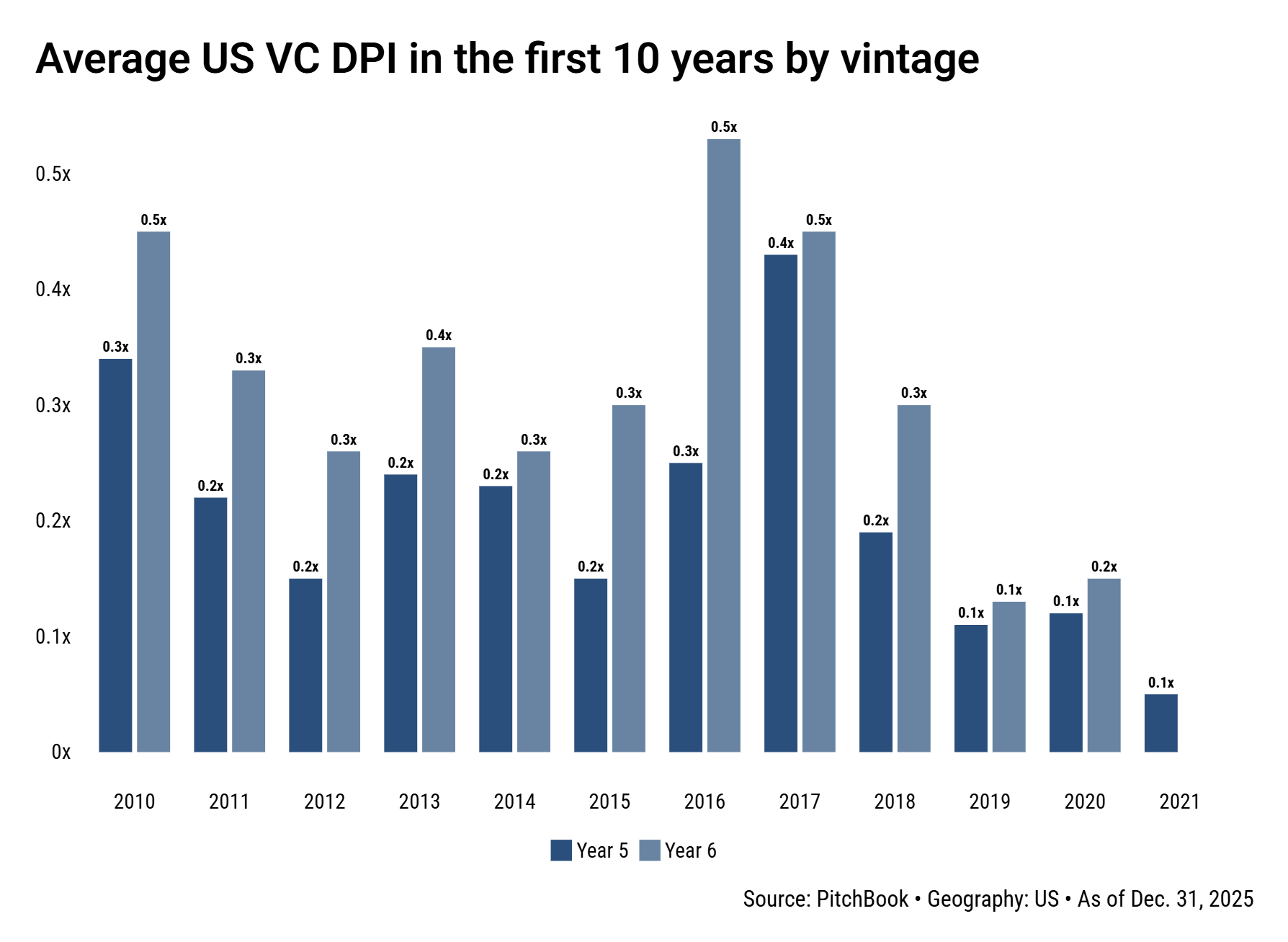
Five years in, at the halfway mark of a ten-year fund, 2021 vintage US VC funds have returned 0.05x DPI, the lowest five-year distribution multiple of any vintage since at least 1997 according to PitchBook, and for every $100 an LP put in, they have received $5 back in actual cash. Not paper gains. Cash.
The 2021 vintage was the biggest by capital deployed in venture history, raised into the highest valuations, the lowest interest rates, and the most open IPO market anyone had seen. Then rates moved, valuations corrected, and the IPO window closed. None of the exits that 2021 GPs pencilled in happened on schedule, and five years later the distributions show it.
The Numbers
The median 2021-vintage fund sits at 1.02x TVPI and 1.4% net IRR. The S&P 500 returned roughly 15% annually over the same period. TVPI barely above 1x means the portfolio is worth roughly what went in, on paper. DPI at 0.05x means almost none of that has converted into actual cash returned to LPs.
The 2022 vintage is already outperforming at the same stage by 20 to 30%, because it deployed at 40 to 60% discounts to 2021 peak valuations. Entry price is as important as company quality, a point that is hard to dispute when you see two vintages investing in the same companies at different prices and producing meaningfully different early returns.
Why LPs Now Prioritise DPI Over IRR
Before 2022, LPs evaluated managers on TVPI and IRR (paper multiples and return calculations that could be inflated by portfolio markups). The 2021 to 2022 period broke that convention.
Distributions fell to 14-15% of NAV from late 2022, leaving LPs unable to rebalance, commit to new funds, or fund new managers. Since 2022, net cash flow to LPs has been negative $202 billion, even as market value and AUM continued to increase. The denominator effect compounded it: as public markets fell, the implied private markets allocation rose above target, and LPs with no distributions coming in could not right-size their portfolios. The result is the fundraising concentration we covered in our PitchBook Q2 2026 piece: 48.1% of all capital raised going to three managers, because those are the ones with demonstrated DPI track records. LPs re-upping with proven managers who have shown they can return cash is rational, not conservative.
The concentration at the exit level is equally stark. Four companies account for 93.5% of 2026 exit value so far, meaning the recovery is being driven by a handful of positions rather than a broad improvement in liquidity conditions.
The Counterargument
Year-5 DPI is a poor predictor of terminal returns, and that may be especially true for 2021. The 2012 vintage had a similarly slow start and delivered 2.04x DPI by year 10. Funds that deployed before an IPO window opened often showed near-zero distributions at the halfway mark before the exit environment cleared.
Source: https://pitchbook.com/news/articles/venture-capitals-current-recovery-is-all-irr-no-dpi
Many 2021 vintage companies are approaching IPO readiness at exactly the moment the exit market is reopening.Half of US VC-backed tech unicorns now exceed $800 million in revenue, the historical threshold before public listings, and if Anthropic, OpenAI, and the cohort around them list over the next 18 months, DPI for funds holding those positions could move fast. Funds with 1.02x TVPI and near-zero DPI are waiting for that window. Funds with written-down TVPI and near-zero DPI are in a structurally different position.
What It Means for Secondaries
The DPI problem is one of the biggest structural drivers behind secondary market growth, which we covered in ourpiece on the $226 billion secondary market. LPs who cannot wait for natural exits are selling positions in the secondary market now to generate liquidity, creating entry points for buyers willing to take the hold period at a discount to NAV.
GP-led continuation vehicles are growing for the same reason: GPs extending hold periods on strong assets while offering liquidity to existing LPs who need distributions. For investors accessing private markets through structured positions, the secondary market that grew out of the 2021 vintage liquidity problem is one of the more interesting entry points in the current cycle, buying from motivated sellers rather than competing for oversubscribed primary rounds.
NonPublic Pty Ltd (ABN 49 607 216 928) holds Australian Financial Services Licence #482668. Investments are available to wholesale and sophisticated investors as defined under the Corporations Act 2001. This content is general in nature and does not constitute financial product advice. It does not take into account your objectives, financial situation, or needs. Investing in private markets involves significant risk, including the potential loss of your entire investment. Past performance is not a reliable indicator of future results. You should obtain independent financial advice before making any investment decision.
