Quantum Computing Is Creating a New Computing Stack. Here's Where the Next Opportunities May Emerge
In August 2024, the US government began instructing banks, agencies and infrastructure operators to replace the cryptographic foundations of the modern internet — despite the fact that no machine capable of breaking that cryptography yet exists. This is not how governments typically behave. Regulatory urgency of this kind is usually reserved for threats already realised, not ones still confined to research papers and laboratory prototypes. When institutions move early, it tends to mark a shift already underway.
Governments across the US, Europe, and Asia have committed roughly $40B to national quantum programmes. In 2025, venture investors put $12.6B into quantum start-ups, about 6.3x the previous year's total, with roughly 90% going to quantum computing, according to McKinsey. The money is coming from an unusual mix of backers. BlackRock has led or co-led the largest rounds, including PsiQuantum's $1B raise, while Nvidia's venture arm, NVentures, invested in three separate quantum hardware companies in a single week in September 2025, spreading bets across three competing architectures at once. JPMorgan, Microsoft and Amazon have made their own strategic commitments. Every large technology company, from IBM and Google to Microsoft and Amazon, is now building a quantum ecosystem.
The money has run far ahead of the revenue, which is the first thing an investor should notice. The entire quantum-computing industry sold a little over $1B of product in 2025 - most of it in research contracts and hardware rather than production work. Quantinuum, the most valuable pure-play, went public in 2026 at around $15B while booking roughly $31M in revenue and a $193M loss, close to 500 times sales. Nobody is paying those prices for current cash flows. They are paying for a computing platform that does not exist yet.
Much of the discussion has centred on which company will build the first commercially useful quantum computer. For investors, a more important question is where the economic value will ultimately accrue.
Platform technologies rarely reward the obvious company. Artificial intelligence produced OpenAI, but the durable profits went to the suppliers underneath it. Nvidia in chips, TSMC in fabrication, SK Hynix in memory, and the networking and power vendors that fed the data centres. The internet created more lasting value in routers, fibre and cloud infrastructure than in the first search engines. Quantum computing may follow a similar pattern. The difference is that its ecosystem is still taking shape, and where value ultimately accrues will depend on which technologies become commercially viable.
Why Quantum Computing Matters Now
In 1994, mathematician Peter Shor showed that quantum computers could solve certain problems exponentially faster than classical machines, including factoring the large numbers underpinning much of modern internet encryption. The hardware simply did not exist to test the idea.
The decisive evidence arrived in December 2024, when Google's Willow processor did something the field had chased since the 1990s. For years, adding more qubits to a quantum computer added more errors, which is why the machines stayed useless. Willow reversed that. Each time Google enlarged its error-correcting grid, the error rate roughly halved, and the encoded memory outlived its best single component. Published in Nature, the result was the first hard evidence that a large, reliable quantum computer is an engineering problem rather than a physics fantasy.
A qubit is the basic unit of information in a quantum computer. Unlike classical bits, today's qubits are vulnerable to heat, electromagnetic interference and other environmental noise, which makes them highly error-prone. As a result, a useful quantum computer cannot rely on individual qubits alone. It must combine many physical qubits to produce a much smaller number of error-corrected logical qubits capable of performing reliable calculations. Producing those logical qubits, and doing it without needing millions of physical ones for each, has become the industry's defining engineering challenge.
That engineering challenge is now shaping the industry's roadmap. IBM has committed to a machine called Starling by 2029, designed to run 200 logical qubits through 100 million operations, and a larger system, Blue Jay, aiming for 2,000 logical qubits by 2033. As of late 2025, the most advanced systems, such as Quantinuum's Helios, operated with only a few dozen logical qubits, so these are steep targets rather than incremental ones. IBM now markets its roadmap in logical qubits rather than raw counts, a sign the field has moved from lab demonstrations toward machines built to do real work.
Willow did not make quantum computing commercially useful. It changed something subtler. It moved quantum from an open scientific question to an engineering and scaling problem, and that distinction decides who is willing to pay. Governments and national labs fund science for its own sake, tolerating twenty-year horizons and unknown commercial payoffs, which is why roughly $40B in public money was committed while returns were still theoretical. Private capital works to a clock. The venture funds of the 1970s were patient enough to underwrite a decade of hard technology, but today's venture and growth vehicles typically need returns inside seven to ten years, sometimes less. What Willow offered that second group was not a product but a derisking, an engineering roadmap they could underwrite, where before there was only scientific uncertainty they could not.
Governments now treat quantum computing as strategic infrastructure, alongside artificial intelligence and semiconductors. The largest funding commitments come from China, the United States and leading European economies, reflecting priorities that extend beyond science to defence and economic competitiveness.
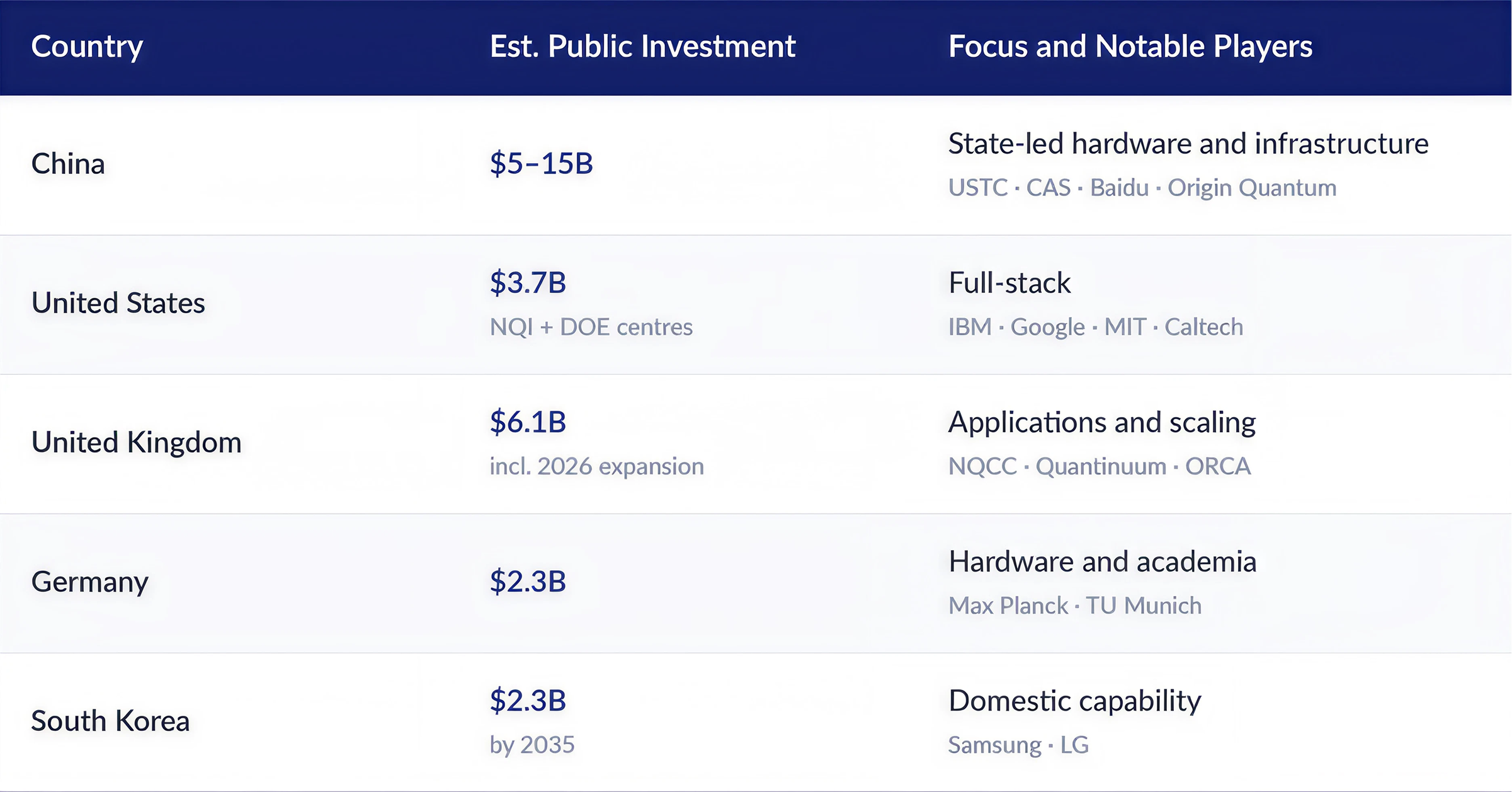
None of this made quantum computing suddenly work. It made the timeline believable, and a believable timeline is what changes an investment case.
Why the World's Fastest Supercomputers Still Aren't Enough
The commercial case for quantum computing does not depend on replacing today's computers. It depends on solving a narrow class of problems that remain economically impractical regardless of how much classical computing power is added. Those bottlenecks already cost industries billions of dollars each year through approximation, simulation limits and optimisation trade-offs.
The limitation is easier to understand by looking at the world's fastest supercomputer. El Capitan at Lawrence Livermore National Laboratory reached roughly 1.8 exaflops in late 2025, performing around 1.8 quintillion calculations per second. Yet many quantum systems remain beyond its reach because the challenge is not processing speed but exponential complexity.
Molecular simulation illustrates the problem. As more electrons are added to a molecule, the number of possible interactions grows exponentially. A system of 100 interacting quantum particles has roughly 2¹⁰⁰ possible quantum configurations, around 10³⁰. Even storing that information would require more memory than could ever be built from the matter available on Earth. Chemists therefore rely on approximation methods such as Density Functional Theory (DFT). These perform well for many molecules but become unreliable for strongly correlated systems, including advanced catalysts, superconductors and enzyme active sites.
One of the best-known examples is FeMoco, the enzyme that enables biological nitrogen fixation. The industrial alternative, the Haber-Bosch process, consumes 1-2% of global energy, making improved catalyst design a multibillion-dollar opportunity. The boundary between classical and quantum computing, however, continues to evolve. Researchers once believed FeMoco required around 100 logical qubits to simulate accurately, but a classical breakthrough in 2026 solved that specific model instead. The lasting commercial opportunities will be the problems that remain quantum-hard even as classical algorithms improve.
Optimisation presents a similar challenge. Logistics networks, financial portfolios and electricity grids all involve vast numbers of possible combinations, forcing classical systems to settle for good-enough solutions rather than provably optimal ones. Quantum algorithms may eventually search these spaces more efficiently, although no general speed-up has yet been demonstrated. The near-term opportunity lies in better approximate solutions for carefully structured industrial problems.
Those applications are already beginning to emerge. Volkswagen used quantum optimisation to route buses in Lisbon, Ford Otosan reduced production scheduling for a 1,000-vehicle manufacturing run from around 30 minutes to under five, and HSBC and IBM improved bond-trade execution predictions by up to 34% using data from 1.1 million trades across more than 5,000 bonds. None represents mass adoption. Together, they show quantum computing is beginning to solve specific commercial problems rather than remaining solely a laboratory experiment.
Where the Value Extends Beyond the Hardware
Investors naturally focus on the race to build the first useful quantum computer. History suggests that is the wrong place to look. Platform shifts often reward the infrastructure every winner depends on more consistently than the winner itself. The AI build-out made Nvidia, TSMC and SK Hynix indispensable regardless of which model company came out ahead. The equivalent question for quantum is simple. Which suppliers get paid no matter whose machine wins, and no matter how long the technology takes to mature?
The answer is not uniform across the stack, and the differences are where the opportunity lies. The strongest position sits in cryogenics. Every superconducting quantum computer, the architecture IBM and Google are scaling fastest, must be cooled to within a fraction of a degree above absolute zero using a dilution refrigerator. That market is highly concentrated. Bluefors is widely regarded as the market leader, with roughly one-third of the installed base and more than 1,800 systems shipped, while Oxford Instruments and Leiden Cryogenics are among the few other established suppliers. Lead times already run 6-9 months against hardware cycles of 12-18 months, which means the supplier, not the quantum-computer builder, sets the pace of deployment. This is the closest analogue to the economics that made TSMC indispensable in semiconductor manufacturing or high-bandwidth memory indispensable for AI. The constraint sits upstream, where every hardware company depends on the same small group of suppliers.
A tighter choke point sits one layer deeper. Every dry dilution refrigerator needs a sub-4-kelvin pulse-tube cryocooler, a market dominated by Cryomech, now owned by Bluefors, and Japan's Sumitomo. Below that sits the rawest constraint of all, helium-3, the refrigerant these systems consume, which is recovered almost entirely as a byproduct of nuclear-weapons material and whose price, by one market estimate, has risen from under $100 a litre to as much as $20,000. A scarce physical input controlled by a handful of suppliers is the most defensible moat in the entire industry, and among the least discussed.
The critical caveat is that this moat is an architecture bet. It pays only if superconducting and silicon-spin qubits remain central. Trapped-ion and neutral-atom systems use no dilution refrigerators, relying instead on precision lasers and ultra-high-vacuum systems. At first glance, that appears to create an equivalent investment opportunity. The economics are different. The laser industry already serves large end markets including telecommunications, medical imaging and industrial manufacturing, making quantum a relatively small source of demand. As a result, quantum alone is less likely to confer the same pricing power or strategic importance that cryogenic infrastructure could.
Only a handful of infrastructure layers appear relatively insulated from architecture risk. Helium-3 and sub-4-kelvin cryocoolers remain essential wherever superconducting systems persist, while software platforms such as Qiskit, Nvidia CUDA-Q and Microsoft's Azure Quantum support multiple hardware approaches. The difference is economic. Physical bottlenecks derive pricing power from scarcity, whereas software platforms depend on developer adoption and ecosystem lock-in.
Quantum sensing is already the most commercially mature segment of the quantum industry. Unlike fault-tolerant quantum computers, quantum sensors are being deployed today in defence, aerospace and critical infrastructure. They include ultra-precise gravimeters, magnetometers, atomic clocks and inertial navigation systems capable of operating without GPS. In October 2025, IonQ strengthened its position in the market by acquiring Vector Atomic, adding more than $200M in US government contracts alongside a portfolio of field-proven atomic clocks, gravimeters and inertial sensors used in national security programmes. Other companies, including Infleqtion, AOSense and SandboxAQ, have already flown quantum navigation systems on military and commercial aircraft, while quantum sensing payloads have been tested aboard missions such as the US Air Force X-37B. Quantum communications remain at an earlier stage, with the quantum key distribution (QKD) market estimated at hundreds of millions to low-single-digit billions of dollars in 2024 and 2025, but forecasts suggest it could reach $10-15B by 2035, driven primarily by governments and operators of critical infrastructure.
Cloud will sit above the entire stack. Few organisations will own a quantum computer outright because the machines are expensive, delicate and require specialised infrastructure. Instead, quantum hardware will increasingly be consumed through cloud platforms alongside CPUs and GPUs, allowing developers to access specialised quantum processors only when a workload genuinely benefits. This model lowers the barrier to adoption and closely mirrors how AI infrastructure has scaled over the past decade, with quantum becoming another specialised compute resource rather than a standalone replacement for classical systems.
What Could Delay This Thesis
The stack argument has to survive its strongest objections, and three are worth taking seriously.
The first is timing and scale. The AI and internet stacks paid off because the core product had immediate mass demand. Quantum has no proven commercial workload yet, and the industry's entire annual revenue, just over a billion dollars, is smaller than what Nvidia earns from data centres in a matter of days. The suppliers have almost nothing to sell into today, and may not for a decade. McKinsey's projection that quantum could unlock up to $2.7T in value by 2035 is real, but roughly 80% of that would flow to end users in pharmaceuticals, finance and materials, not to the technology's vendors, and not soon.
The second is that classical computing keeps catching up. Every claimed quantum advantage invites classical researchers to close the gap, as the 2026 FeMoco result showed. The list of problems that stay permanently beyond classical reach may be shorter than the pitch decks assume.
The third is that the roadmaps may slip. Quantum timelines have a long record of sliding, and at least one leading approach, Microsoft's topological qubits, is still scientifically contested. A business model resting on a 2029 milestone is exposed if that date moves. None of this sinks the stack thesis, but it narrows the opportunity in workload, concentrates it by architecture, and pushes it later than the AI comparison implies.
The Earliest Winner May Be Cybersecurity
The clearest early revenue in quantum is not in computing. It is in defending against it. The public pure-plays tell a consistent story. Government contracts, optimisation software and cybersecurity generate revenue today, while fault-tolerant quantum computing remains a longer-term prospect. IonQ became the first publicly listed quantum company to surpass $100M in revenue while expanding into quantum networking and security, including a metro-network quantum security product. The first durable commercial opportunity is defensive, driven by the need to prepare for quantum rather than by quantum computers themselves.
Most of the internet relies on RSA and elliptic-curve cryptography, whose security rests on mathematical problems that a sufficiently large, fault-tolerant quantum computer running Shor's algorithm could eventually solve. Symmetric encryption such as AES-256 remains resilient with longer keys, so the threat is concentrated in public-key cryptography rather than encryption as a whole.
That risk has already changed behaviour through a tactic known as "harvest now, decrypt later", in which adversaries capture encrypted data today with the expectation of decrypting it once sufficiently powerful quantum hardware becomes available. Information that must remain confidential for decades, including state secrets, medical records and intellectual property, is already exposed to this long-term risk.
That milestone remains distant. A widely cited 2025 estimate by Google's Craig Gidney suggests breaking RSA-2048 would require fewer than one million high-quality physical qubits. Even after a substantial reduction from his 2019 estimate of around 20 million qubits, IBM's 1,121-qubit Condor processor shows the industry remains roughly three orders of magnitude away. The revision also illustrates that progress comes from algorithmic advances as well as improvements in hardware.
Governments are not waiting because replacing cryptographic infrastructure takes years. NIST finalised its first post-quantum cryptography standards in August 2024, allowing banks, government agencies and critical infrastructure operators to begin migrating well before a cryptographically relevant quantum computer exists. The first wave of quantum spending therefore resembles a cybersecurity upgrade cycle, spanning software, consulting and hardware refreshes, rather than revenue generated by quantum computers themselves.
Every Transformative Technology Arrives Before Society Is Ready
Fear of new technology usually arrives before the technology is dangerous, and society tends to adapt rather than retreat. When cars reached Britain, Parliament passed the Red Flag Act of 1865, capping their speed at walking pace and requiring someone to walk ahead waving a red flag. The law reflected real safety worries and heavy lobbying from the railway and coaching industries, and it held back British carmaking until its repeal in 1896. Aviation followed a calmer path, as decades of engineering, regulation and training turned genuinely dangerous early aircraft into the safest way to travel. The internet is the closest match, since early fears of fraud and cybercrime were justified, and the response was not to abandon it but to build HTTPS, digital certificates and an entire security industry around it.
Post-quantum cryptography is the same adaptation running ahead of schedule, with the defence standardised before the threat is real. These parallels carry a warning for investors. They show that quantum will probably be adopted. They say nothing about when the surrounding businesses become profitable. Inevitable adoption and good timing are not the same bet.
Looking Beyond the Qubits
The temptation is to treat quantum computing as a search for the company that builds the first commercially useful machine. History suggests platform shifts rarely create value that neatly. AI rewarded Nvidia, TSMC and high-bandwidth memory because every model developer depended on the same infrastructure. Quantum computing is likely to follow a similar pattern, although the bottlenecks are less obvious and, in many cases, still privately held. That makes the investment opportunity less about predicting the eventual hardware winner and more about identifying the suppliers every credible programme must continue funding regardless of how quickly the technology matures.
Today, cryogenic infrastructure appears to be the strongest example. Every superconducting quantum computer requires dilution refrigerators, cryocoolers and specialised materials before it can generate a single dollar of commercial revenue. Those suppliers benefit from research spending, government procurement and prototype deployment years before fault-tolerant quantum computing becomes commercially viable. They do not need quantum computing to transform the economy overnight. They only need IBM, Google, Quantinuum, Rigetti and others to keep building larger and more capable systems.
That does not eliminate risk. Cryogenics remains an architecture bet, and alternative approaches such as trapped-ion or neutral-atom systems would shift value elsewhere. The better lesson is broader. As quantum computing scales, capital is unlikely to flow evenly across the ecosystem. It will concentrate around the technical bottlenecks that every leading developer struggles to replace. Those bottlenecks may sit in cooling systems, specialised components, enabling software or entirely different parts of the stack that emerge over the next decade.
For investors, that distinction matters. The biggest winner may not be the company that eventually builds the world's most powerful quantum computer. It may be the business that quietly supplies every serious contender along the way. If quantum computing becomes the next foundational computing platform, the most durable returns are likely to accrue where every dollar of industry investment must pass first.
NonPublic Pty Ltd (ABN 49 607 216 928) holds Australian Financial Services Licence #482668. Investments are available to wholesale and sophisticated investors as defined under the Corporations Act 2001. This content is general in nature and does not constitute financial product advice. It does not take into account your objectives, financial situation, or needs. Investing in private markets involves significant risk, including the potential loss of your entire investment. Past performance is not a reliable indicator of future results. You should obtain independent financial advice before making any investment decision.