
Hyperscalers and Nvidia Are on Pace to Issue a Record $320 Billion in Bonds This Year, Up $120 Billion From 2025
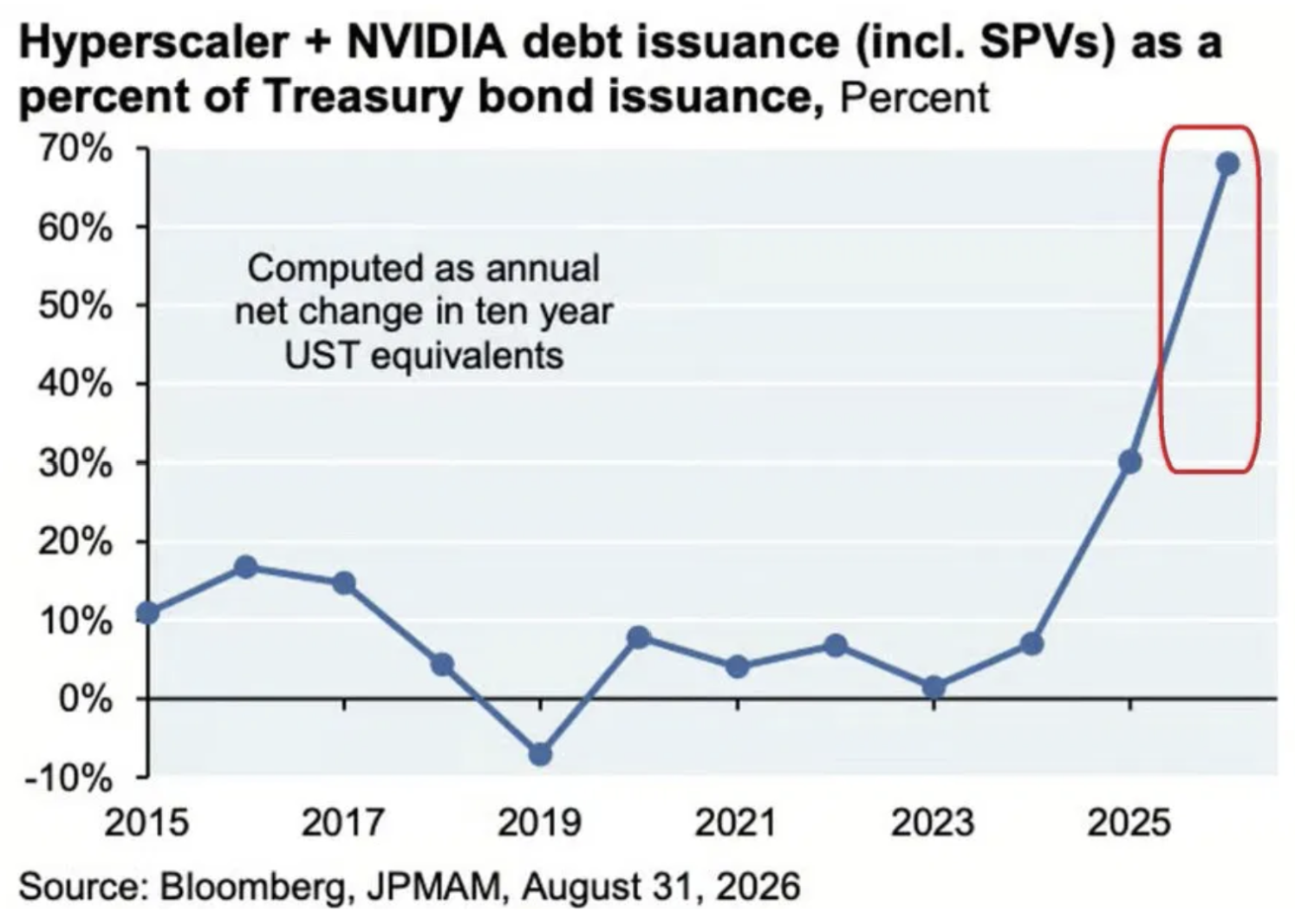
Debt issuance by the five major hyperscalers plus Nvidia has reached roughly US$320 billion in 2026, up from about US$200 billion in 2025, according to J.P. Morgan Asset Management's Michael Cembalest. That figure includes special purpose vehicles, or SPVs, where these companies act as backstop obligors on data centre leases rather than borrowers of record. Looking only at the long-duration component, Cembalest estimates around US$310 billion in ten-year equivalents, which he puts at roughly 70% of new US Treasury long-duration issuance this year, up from about 30% in 2025 and close to zero in 2024.
That is the number worth sitting with. Big Tech's AI buildout has grown large enough, in one narrow but important corner of the bond market, to compete directly with the US government for the same pool of long-duration capital.
Where the Number Comes From
The figure traces to Cembalest's September 1, 2026 Eye on the Market, and the chart has since been picked up widely, including by Seeking Alpha, which confirmed the same year-over-year jump. It sits inside a broader trend that other analysts have been tracking independently. Morgan Stanley forecast in June that hyperscaler bond issuance would reach roughly US$400 billion for the full year, up from US$165 billion in 2025, a separate estimate that points in the same direction even though the exact figures differ depending on which entities and instruments are counted.
The visible bond issuance alone tells part of the story. S&P Global counted roughly US$225 billion in hyperscaler and related-entity bonds through the middle of the year, putting them on pace for a record annual total. But Fortune reported in July that so-called hidden borrowing across the five hyperscalers, structures that don't show up as straightforward bond issuance, has ballooned to roughly US$1.65 trillion. That's the piece Cembalest's SPV figure is pointing at directly.
Why the SPV Detail Matters
The SPVs in this chart are not the kind used to pool capital for venture investors. They're structures where a hyperscaler leases data centre capacity from a vehicle, then backstops that vehicle's debt as guarantor, which keeps the borrowing off the parent company's own balance sheet while the underlying economic exposure remains just as real. That's the mechanism behind the "hidden leverage" framing that's shown up in several analyst notes this year: a company's headline balance sheet can understate its true obligations by a wide margin once SPV-based lease financing is added back in.
Nvidia's own return to the bond market is a useful marker of how fast this has moved. The chipmaker priced a US$25 billion investment-grade offering in June 2026, its first bond sale since 2021, with tranches stretching out to a 30-year maturity. Alphabet followed in February with a seven-part deal that included the first century bond issued by a technology company since Motorola in 1997. Neither company needed the cash in any conventional sense. Both were locking in long-duration capital to fund a buildout that increasingly runs through SPV-financed data centre commitments alongside straightforward corporate bonds.
The Crowding-Out Question
Not everyone reads the 70% figure as a warning sign. Bloomberg reported that JPMorgan Asset Management's own Stephanie Aliaga takes a more sanguine view than Cembalest's chart implies, arguing the bond market can absorb the growing supply because rising AI demand backs the companies' ability to service what they've borrowed. Sage Advisory's analysis frames the volatility in hyperscaler bond spreads this year as a supply problem rather than a credit quality one, noting that ratings agencies have kept the highest-quality issuers at AA without meaningful pressure.
Moody's has made a similar distinction: the balance sheets remain some of the strongest in corporate credit, even as the companies undergo what the agency describes as a structural shift away from the asset-light, software-driven model that defined them for the past decade. The concern isn't imminent default. It's that a growing share of the AI economy's true financing cost sits in places that don't show up cleanly in a 10-K, and that as more of it gets priced into the long end of the Treasury curve, the market's capacity to keep absorbing it at current spreads is an open question rather than a settled one.
What This Has to Do With SPVs More Broadly
The mechanics here are the same wrapper used across pre-IPO investing, a standalone legal entity holding one asset on behalf of whoever is backing it, just applied to a completely different purpose. A venture-style SPV pools capital from investors and holds equity in a startup. A hyperscaler's SPV in this context typically holds a lease or financing obligation tied to physical infrastructure, with the parent company standing behind it as guarantor. Same structure, same reason for existing (isolate an asset and its financing from the sponsor's core balance sheet), completely different risk profile on either side of the transaction.
It's a reminder that SPVs aren't a niche tool reserved for angel syndicates and secondary share sales. They sit at both ends of the private capital stack now, from a single investor backing one pre-IPO company through platforms like NonPublic, all the way up to how the largest technology balance sheets in the world are financing hundreds of billions of dollars in AI infrastructure. The wrapper is identical. What it's holding, and who bears the risk if it doesn't work out, is the part worth reading past the headline number to understand.
NonPublic Pty Ltd (ABN 49 607 216 928) holds Australian Financial Services Licence #482668. Investments are available to wholesale and sophisticated investors as defined under the Corporations Act 2001. This content is general in nature and does not constitute financial product advice. It does not take into account your objectives, financial situation, or needs. Investing in private markets involves significant risk, including the potential loss of your entire investment. Past performance is not a reliable indicator of future results. You should obtain independent financial advice before making any investment decision.
